Showing posts with label Arab Spring. Show all posts

Friday, 18 November 2016

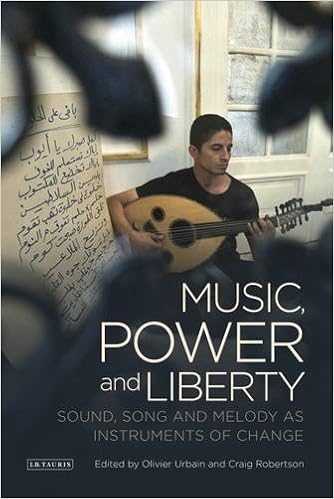
Music, Power and Liberty: Book is out now!

Olivier Urbain and I edited this book which came out of a conference on music and peacebuilding in Paris a few years ago. Here is the abstract and a link:

Music is a complex and multi-faceted art form. Yet too often it is regarded as discrete and self-contained. The chapters in this groundbreaking book explore different aspects of how music may shape society and culture, yet go much further in viewing musical activity as a mode of power that can transform the lives of communities and individuals. The contributors (who include sociologists, musicologists and performers) focus above all on the relationship between music and the political upheavals of the Arab Spring. They examine key topics like music and revolution in Tunisia; the Egyptian musical tradition of the Revolutionary Song; and the ambivalent social status of the Arab musician, revered by the public when performing but also facing suspicion in a society where music is rightly seen as dangerous and subversive. In showing how music has been used to challenge the status quo, as well as enforce it, the ambiguity of music is fully revealed: it can be used to bolster both regime power and popular liberty, often simultaneously. This is a vital contribution to more nuanced understandings of music and politics.


https://www.amazon.co.uk/Music-Power-Liberty-Instruments-Institute/dp/1784534447

Tuesday, 27 March 2012

Another article on the Salafist protest in Tunis


Several Thousand Salafists Demonstrate for Islamic Law, Attack Dramatists in Tunis

 | 25 March 2012 35 Comments
Salafist demonstrators wave Caliphate flag on top of Tunis clocktower
A group of several thousand Salafists and their supporters demonstrated in downtown Tunis today in support of the Koran, claiming that the Muslim holy book was under threat by more secular elements of Tunisian society. Demonstrators climbed the clock tower of Tunis to fly black caliphate flags from the top of the tower and chanted slogans such as “the people want a new caliphate.”
At the same time and on the same street, the Tunisian Association for Drama Arts held a celebration for the upcoming World Day of Theater (usually March 27th) in front of the Municipal Theater. As the Salafist protest came to a close, a number of Salafist demonstrators attacked the Theater celebration.
According to Yassine Ouni, a student from the Higher Institute for Drama, the Ministry of Interior was responsible for the confrontation because they gave permits for both events knowing there would be a conflict. “The Tunisian Association for the Drama Arts event and the Salafist demonstration was held at the same time. We want to hold the Interior Ministry accountable since it gave permission to the two movements on the same day and the Ministry knew there would be tension since Drama is sacred for all artists and religion is sacred for every citizen.”
Salafists gather in front of the Municipal Theater
The permit given to the dramatists was supposed to allow them to celebrate theater in the space between the municipal theater and the Africa Hotel while the Salafists had a permit to demonstrate by the Tunis clock tower. While the Salafist organizers agreed to separate the events at first, a group of  Salafists later came and damaged equipment, disrupted outdoor performances and threw eggs, empty bottles and sharp objects at those celebrating theater.
Fawzi Guara, one of the demonstrators at the Salafist organized event for supporting the Koran blamed the theater celebration organizers for the confrontation. “Some Tunisians are not respecting our religious sanctity, campaigns against our religion confirm that there are elements here who want to provoke us. They don’t respect our views.”
Members of the Tunisian Association for Drama Arts in front of the Municipal Theater
Guara admitted that the Tunisian Association for Theater had received permission to hold an event first, but he said the Koran was more important than theater. “We knew they got permission before us, but they should give priority to defending the Koran and our religion. Anarchy can happen at any time, and simply by calling themselves ‘Theater of Resistance’ they are provoking us, resistance to whom? Did we sell out our country?”
For Guara, his demonstration was necessary because he sees Islam as being under attack. “Today Tunisia is witnessing a historical day. Tunisians went to the street to show their disapproval against the desecration of the Koran in Ben Guerdene, against the six pointed star on the wall of the Al-Fateh Mosque.”
He added that opponents of Salafists have been making a big deal out one Salafists’ desecration of the Tunisian flag at Mannouba University, just to give them a bad name. “We do love our country and our flag but the priority is for our religion and what is sacred. Islam does not oppose civility. We are here today to express our love for the Koran, for the prophet, for our holy sites. Our slogans are in support of the Koran, defending that which is sacred and rejecting discord and strife between Tunisians,” Guara said.

Salafist Protest in Tunis

Here are some articles about the Salafist protest in Tunis on Sunday, March 26 that I found myself in the middle of. I will post my own take on these events when I get a chance.


Friday, 9 March 2012

Culture war brews between new Islamist movement and secularists in post-revolution Tunisia


Larger Text 


TUNIS, Tunisia — Every Friday, bearded men in shin-length robes demonstrate in Tunisia’s capital against perceived insults to Islam in a country once known for its aggressive secularism. They have occasionally turned violent, attacking secular intellectuals and harassing women for their style of dress.
This emerging movement of believers known as Salafis has seemingly appeared out of thin air — and prompted fears of a culture war in this North African country of 10 million.
  • ( Hassene Dridi, File / Associated Press ) - FILE - This Friday Jan. 20, 2012, file photo shows Tunisian Salafist women demonstrating near the French embassy in Tunis, Tunisia, in support of a Muslim woman who was fined in France for wearing a niqab Muslim veil. An emerging movement of believers known as Salafis has seemingly appeared out of thin air _ and prompted fears of a culture war in this North African country of 10 million. Since the overthrow of President Zine El Abidine Ben Ali in January 2011 unleashed a string of Arab uprisings, Islam has blossomed in Tunisia in a way it wasn’t allowed to do for half a century.Sign reads: Allah is the Only God, and Mahommed is his Prophet.
  • ( Amine Landoulsi, File / Associated Press ) - FILE - This Monday, Jan.16, 2012, file photo shows female ultraconservative Muslims known as Salafists, strolling in the gardens of the Manouba university in Tunis. Salafists held a press conference to announce that 5 students will start a hunger strike Tuesday to demand the right to wear the Niqab. For more than a month classes and exams at Manouba University’s humanities department have been put on hold by a sit-in demanding students be allowed to attend class in the conservative face veil, known as the niqab.
  • ( Amine Landoulsi, File / Associated Press ) - FILE - This Friday, March 2, 2012, file photo shows Salafists holding posters showing Osama bin Laden during a rally to condemn the disposal last week of a number of Qurans at a U.S. military base in Afghanistan, near the U.S. embassy in Tunis, Tunisia. An emerging movement of believers known as Salafis has seemingly appeared out of thin air _ and prompted fears of a culture war in this North African country of 10 million. Since the overthrow of President Zine El Abidine Ben Ali in January 2011 unleashed a string of Arab uprisings, Islam has blossomed in Tunisia in a way it wasn’t allowed to do for half a century.
  • ( Amine Landoulsi, File / Associated Press ) - FILE - This Friday, March 2, 2012, file photo shows Salafist setting a U.S. flag on fire during a rally to condemn the disposal last week of a number of Qurans at a U.S. military base in Afghanistan, near the U.S. embassy in Tunis, Tunisia. An emerging movement of believers known as Salafis has seemingly appeared out of thin air _ and prompted fears of a culture war in this North African country of 10 million. Since the overthrow of President Zine El Abidine Ben Ali in January 2011 unleashed a string of Arab uprisings, Islam has blossomed in Tunisia in a way it wasn’t allowed to do for half a century.
( Hassene Dridi, File / Associated Press ) - FILE - This Friday Jan. 20, 2012, file photo shows Tunisian Salafist women demonstrating near the French embassy in Tunis, Tunisia, in support of a Muslim woman who was fined in France for wearing a niqab Muslim veil. An emerging movement of believers known as Salafis has seemingly appeared out of thin air _ and prompted fears of a culture war in this North African country of 10 million. Since the overthrow of President Zine El Abidine Ben Ali in January 2011 unleashed a string of Arab uprisings, Islam has blossomed in Tunisia in a way it wasn’t allowed to do for half a century.Sign reads: Allah is the Only God, and Mahommed is his Prophet.

Since the overthrow of President Zine El Abidine Ben Ali in January 2011 unleashed a string of Arab uprisings, Islam has blossomed in Tunisia in a way it wasn’t allowed to do for half a century.
New religious freedoms have also opened the way for the Salafis, who are now in a daily battle for hearts and minds with equally hardline secular elements entrenched in the media and the elite. Television stations, Western embassies and government offices have all felt the conservatives’ wrath.
In the middle are the moderate Islamists who won Tunisia’s first free elections and are trying to build a democratic model for countries that followed Tunisia down this still uncertain revolutionary path.
The Salafis say they are just reclaiming rights long denied.
“Tunisians are thirsty for religious knowledge,” said Mohammed Bedoui, a young adherent of the Hizb al-Tahrir, or Liberation party, which calls for the return of the Islamic caliphate. “The regime of Ben Ali neglected the religious universities and the Tunisian imams just can’t answer to the demand.”
The war of words is taking place against a backdrop of armed radical movements just over the porous borders in neighboring Algeria and Libya, and there are worries that Tunisia’s aggressive demonstrations could evolve into an armed struggle if the competing demands are not handled carefully.
Secular intellectuals describe the Salafis as backward and engaging in a wholesale assault against freedom of expression and Tunisia’s progressive traditions. The religious conservatives — distinctive with their mustache-less beards, short robes and sneakers — counter that their religion is under daily attack.
“The demonstrations are a response to the provocations of the secularists and the leftists, particularly the polemic against the niqab (face-covering veil) in universities,” said Bedoui.
The Salafis cite the broadcast of blasphemous movies, publication of seminude photos of models in newspapers and bans on women wearing the veil as attempts to target and provoke them. They call the secularists leftover supporters of the old dictator.
In one of their most high profile sit-ins, demonstrators stalled exams at a university near Tunis for weeks protesting a ban on female students wearing the niqab during exams.
In October’s elections, the moderate Islamist party Ennahda dominated the polls, though most believe that people voted for them not out of religious conviction but because they trusted them to do away with the old system and get the country back on track.

Said Ferjani, a high ranking member of Ennahda, told The Associated Press that the last thing they wanted right now was a culture war between the Salafis and what he calls the “secular fundamentalists.”
“We are dealing with the business of government, we have floods in the north, a sinking economy and these people are talking about the burqa and the hijab (headscarf),” he said with exasperation. “I don’t think they are very grown up.”

During the election campaign, leftist parties tried to paint Ennahda as closet conservatives seeking to drag the country back to the Middle Ages. Voters didn’t agree, but now with the rise of the vocal Salafi minority, secularists have found the “bearded menace” they have been looking for.
The secularist opposition maintains that Ennahda not only sympathizes with many of the Salafi positions, but may be actually promoting them.
“Sometimes the line between the Salafis and Ennahda’s activists are a bit blurred,” said Kamel Labidi, a former journalist now heading the committee rewriting the country’s media law.
Under Ben Ali, some of the Salafis joined armed groups that were quickly squashed. But now with Libya next door flush with weapons from the civil war, the means for a new armed rebellion are easily at hand.
On Feb. 2 border guards stopped a car in the south filled with three bearded men at a checkpoint who opened fire with assault rifles before fleeing into nearby olive groves, sparking a major police security operation. Two of the men were shot dead; the third, who was captured, revealed the existence of a violent network with dozens of members across the country.
While such incidents are rare, elements of the Salafi movement have shown a disturbing tendency toward bullying behavior, such as harassing women in smaller towns for not abiding by conservative dress.
In one incident a prominent secular intellectual and a newspaper editor were punched and kicked by a crowd of Salafis protesting outside a courtroom.
Ferjani of Ennahda said that the government is trying a lenient approach with the Salafis so that they aren’t further radicalized, attempting to address their concerns with education and religious debate rather than just denouncing them as backward.
“If you push these people, you are empowering them,” he warned.
Copyright 2012 The Associated Press. All rights reserved. This material may not be published, broadcast, rewritten or redistributed.

Tuesday, 6 March 2012

Toda Institute Music, Power and Liberty Conference


In early February this year I presented at the Toda Institute's Music, Power and Liberty Conference in Paris. The Toda Institute is infamous in my mind for publishing the first academic book on the subject of Music and Conflict Transformation entitled, funnily enough, Music and Conflict Transformation, edited by the director of the institute, Olivier Urbain. Due to the leading nature of such a publication I have naturally analysed pretty much every page in depth and I unfortunately found it generally wanting in terms of empirical and theoretical rigour or practical application. So it was with some trepidation that I accepted the invitation for this conference. I am happy to report that my fears were unfounded. I found the papers presented at conference stimulating, utterly relevant, and the approaches significantly more grounded and realistic than in the previous 2008 publication. There is a slight danger of perhaps too much cynicism, but there still seems to be enough drive and optimism to keep the momentum going.
The papers presented in Paris will eventually make their way into a book to follow the original Music and Conflict Transformation book, and since I will most likely be involved in this project to one degree or another, I will not comment on each paper just yet. Suffice it to say for now that there were three broad categories that were addressed:

1) Music, Power and Social Change: Music has been actively engaged with in the socio-cultural arena to influence the status quo; either to keep it static or to challenge and overturn it. There were many presenters from North Africa and their talks were completely resonant with my current research on the role of the arts in the Arab Spring.

2) Unification versus Censorship: There is the age old battle of using music as a tool of expressing togetherness and/or fostering social unification versus powers that would rather keep people apart, usually for social control purposes. There is also the continued battle between the romantics and the realists.

3) How music influences belief systems through education and technology: Increasingly researchers are talking about belief and how this is a key factor in behaviour and also how music and education influence belief. More recently there have been studies on how music and education is transmitted via social media and other technological platforms, thus effectively spreading belief.


Grenoble, France Hosts Festival Commemorating the Tunisian Revolution

 | 30 January 2012 0 Comments
Grenoble, France will host a cultural festival celebrating, and reflecting upon, the Tunisian Revolution. The festival, “Tunisia 2012 Between East and West,” will run from February 1st to February 29th.
The event was organized by the Tunisian Consulate in Grenoble, the Community Center of Social Action of Capuche (a center supporting social and cultural activities in Grenoble), local municipal libraries, and several French and Tunisian cultural and social organizations.
The festival will feature an exhibition consisting of different forms of artistic expression – such as theater, cinema, painting, photography, dancing, music, and even cooking.
One of the plays, “Hekayetna,” (“Our Stories” in Tunisian Arabic) by Baghdadi Aoun,  aims at portraying contemporary Tunisian life. The story recalls the trials of a myriad of characters during the Fatimid period, employing powerful and poetic language inspired by the oral heritage of southern Tunisia – expressed through a mix of literary Arabic and Southern Tunisian dialect.
“The goal of my play is to educate the public about the importance of the oral history of Tunisia,” Baghdadi said.
Tunisian cinema will be represented by a number of documentaries and fictional short, and feature-length, films. Among the films to be featured during the festival are, “No More Fear,” by Mourad Bechikh, “Freedom,” by Ferial Ben Mahmoud, and, “Jasmine Revolution,” by Nassar Ayad.  The films all focus on the events surrounding the Tunisian revolution as interpreted through the perceptions of the different directors.
The festival will also include a poetry reading entitled, “The Will of Life,” which will include poems by Abou El Kacem Chebbi – the legendary poet of Tunisia’s independence movement. Chebbi (who lived from 1909-1934) was best known for writing the final two verses of the current national anthem of Tunisia and other evocative, patriotic poems.
“In early 2011, the Tunisian people started the Jasmine Revolution. One year after the uprising that initiated the ‘Arab Spring,’ many actors – but also the libraries of institutions and associations in the city of Grenoble – wanted to honor Tunisia,” said Mohamed, one of the organizers working with the Tunisian Consulate in France.
He explained that the event aims at enhancing cultural life in Grenoble and enlightening French citizens about Tunisian culture and history.

Controversial Tunisian Rapper Arrested in Unclear Circumstances

 | 27 January 2012 2 Comments

Tunisian rapper, Anis Mrabti
Anis Mrabti, a young Tunisian rapper better known by his stage name Volcanis, was arrested at his house on January 25th.
Statements made by Mrabti’s father after the incident, coupled with the political nature of Mrabti’s music, have provoked speculation about the motivations of the police action.
According to Anis’ father, Mongi Mrabti, six men in plain clothes broke into the family house, asked for Anis, arrested him, and confiscated his desktop and MP3 player. The father asked them who they were and they answered that they were police.
“They drove a tinted glass civilian car and they did not show me any arrest warrant or any police ID,” explained the father.
In an interview with Tunisia Live, Mongi Mrabti stated that the Mrabti family was not told where there son had been taken and were not informed of what he had been charged with for nearly two days, until the family received a call from a Tunisian citizen not affiliated with the police who had heard of Anis’ story and made independent investigations. The phone call apparently informed them that Anis had tested positive for drug use, and that his arrest came after others involved in the same “drug case” had given police Anis’ name.
Anis Mrabti became well known recently for his song “Matbadal Chay” (“Nothing has changed” in Tunisian Arabic), which contains sharp criticism of the current political situation in Tunisia. In the song, Mrabti criticizes the Tunisian government, accusing Tunisian politicians of running after power and speaking about the suffering of Tunisian people from bribery and social injustice. The controversial nature of the song has prompted some on social networks to speculate that Mrabti has been arrested for political reasons.
Anis’s father said some human rights organizations contacted him and told him that they will look into the allegation that Anis was arrested without warrant or due process.
The Ministry of the Interior released a statement on its official Facebook page in which they denied all rumors about the arrest being politically motivated, or having anything to do with the lyrics of Mrabti’s song.
This morning, Mongi Mrabti received a call from the police station of Wardiya, a suburb of Tunis asking him to collect his son’s desktop. He has been told that his son will be tried tomorrow in a drug case in Grombalia, in the governorate of Nabeul, the alleged crime said to have taken place in Hamamet, also in the Nabeul governorate.

'No to Military Trials' marks 1st anniversary with music, testimonies
Following release of activists El-Behairy and Nabil, campaign marks first birthday with victims' personal accounts and musical performance by revolutionary band Eskenderella
Ahram Online, Monday 27 Feb 2012

No Military Trials
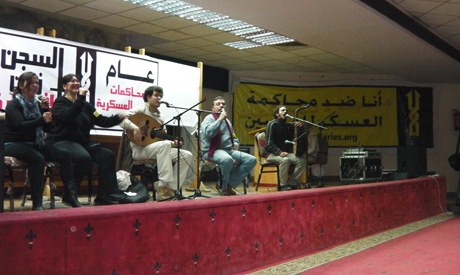
Eskendrella play at the close of the To Military Trials for Civilians press conference, on their anniversary
It's been one year since the night Amr El-Behairy, 32, was beaten by military personnel in front of Egypt's parliament building in downtown Cairo. He was later dragged out of a car, arrested, and sentenced to jail by a military court. Many others that night faced similar fates.
The same day, 26 February 2011, marked the launch of the "No to Military Trials for Civilians" campaign. On 24 March 2011, activists, human rights lawyers and families of detainees held their first group meeting at Cairo's Hisham Mubarak Law Centre. Today, the campaign boasts offices in the capital and Alexandria and conducts countrywide public-awareness campaigns.

The campaign advocates for the release of over 12,000 civilians, including minors, tried and sentenced by military courts in the absence of lawyers and witnesses – or the right to appeal. The conviction rate from these tribunals stands at 93 per cent, with 18 people having been sentenced to death, according to statistics provided late last year by military court head General Adel Morsy.

To date, official figures indicate that 2,613 detainees have so far been released. Finding accurate information about detainees or those facing trial, however, remains extremely difficult. Thousands of others, meanwhile, remain unaccounted for.

In October of last year, Field Marshal Hussein Tantawi, head of Egypt's ruling military council, announced a halt to the practice of referring civilians to military courts – with the notable exception of cases falling under Egypt's longstanding emergency laws. Many human rights activists, however, say the latter proviso renders the move meaningless.
The "No to Military Trials" campaign has been key to securing the release of numerous political detainees. El-Behairy, who was sentenced to five years in jail for attacking military personnel, became an icon of the campaign and Egypt's revolutionary movement. Last week, after almost a full year of campaigning on his behalf, El-Behairy was finally released by authorities.

On Sunday night, the "No to Military Trials" campaign marked its one-year anniversary with a press conference and concert at the Egyptian Journalists Syndicate. Families of those who remain in jail, released prisoners, and victims of abuse by the state all spoke at the event.
Among them was Samira Ibrahim, 25, who sued the government after being subjected to a forced virginity test by an army officer in March of last year. Rasha Abdel Rahman, another virginity-test victim and a witness in Ibrahim's case, announced that she, too, would be filing a complaint, drawing a standing ovation from those in attendance.
Rasha Azab, a well known journalist and activist detained on the same day as Ibrahim, also spoke about her arrest by authorities for broaching the issue in print.

The sister of detainee Mohamed Khaled, sentenced to three years in a military prison in Fayoum, said that she couldn’t recognise her brother when she paid him a visit because he had been so badly tortured.
Some people had even been tortured to death and buried in the desert, said recently-released detainee Abul Maaty. He says he was tortured continuously for four days after being detained in February of last year.
The brother of Essam Atta, 24, who, according to his family was tortured to death while in military detention, spoke about how the official medical report had said that his brother had died of a drug overdose. “We haven’t been able to investigate my brother’s death,” he said, verging on tears.
Mostafa Mohamed El-Ghareeb, a man in his 40s who was slapped with a jail sentence because the military thought he was somebody else, described how he had been stripped and beaten despite having a serious heart condition.

After each person spoke, the room erupted in spontaneous chants against the government and the ruling military council.

Military trial victim Alaa Abd El-Fattah, the renowned blogger detained for over a month by the army for refusing to accept the military court's legitimacy, also attended the event. He was accompanied by his activist wife Manal and mother Laila Soueif, who herself went on hunger strike to demand her son's release.

Ahmed Harrara, the 31-year-old dentist who lost both eyes to birdshot fired by Egyptian security forces, was likewise welcomed to the event with hearty applause.

"It was important to see many of the victims, but we have a long struggle ahead of us," said Maha Maamoun of the "No to Military Trials" campaign. "We're currently working on a new constitution. We’re also working on a draft law to change the articles of Egyptian military law that refer to civilians."

Alongside the release of El-Behairy, the "No to Military Trials" campaign was also recently able to celebrate activist Maikel Nabil's release from jail. The Egyptian blogger was sentenced to jail in March of last year for writing a blog critical of the ruling military council. Nabil withstood a 130-day hunger strike to protest his detention that led to his eventual release in January.

The evening concluded with a performance by revolutionary band Eskenderella, whose song Segn El-Alaa – "The citadel Prison" – is dedicated to those facing military trials.

Rappers in Egypt: A growing community
While rap as a genre has not yet reached mainstream Egyptian audiences, the hip-hop subculture is thriving
Menna Taher, Monday 27 Feb 2012

Black devils family
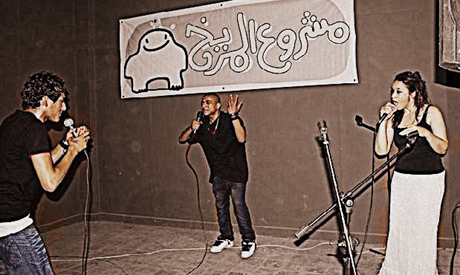
Black devils family performing in an open-mic night
The community of the Egyptian rappers is one of the growing subcultures in Cairo that have taken on a character of their own.

Omar El-Shamei, who is currently making a documentary about Egyptian rappers and is a rapper himself, talked to Ahram Online about the community.

"They’re all very young, and some are exceptionally good at what they do." El-Shamei explained that a lot of groups come from the Shubra district and rap everywhere; on the streets, in cafes, and in Cairo University.

Each has their own nickname, and some do not even know each other's real names.
Some of the names are Egyptian like Dawsha (noise), while others are foreign like Scratchy, Joker or Mr. Folly. But the rap community in Egypt has its own identity.

"The scene in Egypt also has created its own definitions and terms," El-Shamei said "and each group has a very young member that is still learning the art, like an apprentice."

Rappers in Egypt define the different genres as old school, new school, hardcore rap, flipflop, gang and crank. In old school style, certain words are emphasised; the new school style is faster and resembles the style of American rapper Lil Wayne, while crank depends on harmony. 
Hardcore rap takes a slower flow with a more aggressive tone, and gang uses themes of violent street life. "There’s a lot of free spirit," said El-Shamei, "but it’s going to be commercialised soon."
El-Shamei used the example of an event that took place in Tahrir Lounge in Goethe Institute, where rappers were hosted to perform.

"The event had nothing to do with the rappers," El-Shamei said. "It was an event on the launch of a website."

"They ended up taking over the whole show," he recalled. "They break-danced in the hall and rapped outside Goethe. They’re very aware of being energetic in live performances."

"Rapping has become our life," said the rapper Youssef Altay, perched on a car nearby the El Sawy cultural centre.

"There was a time when we used to come here and find everyone," the rapper Dawsha said - referring to the street located by El Sawy Culturewheel.

However, rappers are not widely known in Egypt, despite the growing scene. In concerts, usually other rappers or friends represent majority of the audience.

There are only a few well-known rappers that have made it to the studios – names like MTM, one of the very first bands in the scene, and rap trio Arabian Knightz (Rush, Sphinx and E-Money), who were established in 2006. Another rapper, Ahmed Mekky, has become known very quickly, which many explain by referencing his already-established popularity as an actor. 

The competition of the scene is high and some of the rappers take it very seriously, whereas some rappers are currently hoping to institutionalise the art.

Bel Araby, a project that was launched four years ago, includes rappers, designers, producers and distributors. It also has an institute to teach newcomers to the scene how to rap.

Black Devils Family is a group of hip-hop artists who call themselves a nation. For rappers, a nation includes rappers, break dancers and beat box artists. The nation of Black Devils Family includes four girls and four guys.

Lil Garhy, one of the members of Black Devils Family, says that he prefers to listen to rai music although rap is his favourite style of music to make.

"One of the most important rules for rappers is to write our own music," he said. "We also put a lot of emphasis on the show and have band T-shirts for each concert."

"We also like to include rap in protests," he said, while adding that the revolution has changed the inclination of the band and the themes of its lyrics. "In one of the marches to Tahrir Square we rapped and sung the soundtrack of the film El-Barea (The Innocent)," Garhy reveals.
"We also organised a protest in collaboration with [cultural initiative] Mashrou El-Mareekh, where a rope was held all the way from the Opera House to Tahrir Square," he said. "For us that symbolised the thread of thought that connects people."

Since hip-hop as a culture has its own political undertones and represents the voice of the oppressed, it is not surprising that it has emerged forcefully in countries in the Middle East, especially Palestine, in which rap has become one form of resistance.  

Tunisian rapper Hamada Ben-Amor was detained for three days in January last year, during the protests that led to the ousting of then-president Ben Ali.

According to Reuters, Ben-Amor, who is better known in Tunisian cyberspace as "The General," created a song about the problems of youth unemployment, the focus of much of the unrest that led to the uprising.

In Senegal, youth have created a dissident rapper community called Fed Up, who held protests against a third term candidacy of the president Abdoulaye Wade.

In Egypt, the scene is still in an embryonic stage, although it is developing fast, and the energy of young Egyptian rappers seems interminable.

Check out some of the music below: