Showing posts with label Egypt. Show all posts

Thursday, 21 May 2015

New Article in African Conflict and Peacebuilding Review

The latest African Conflict and Peacebuilding Review contains an article by myself. You can access it here through JSTOR:

Here is the abstract:

Whose Music, Whose Country? Music, Mobilization, and Social Change in North Africa

ABSTRACT Social change began to rapidly emerge in many North African states in 2011 and 2012, and this process continues today. Music has been embedded within this process from the beginning and has been a key feature in street protests and expressing group identity that opposed the status quo at the time. The situation has since become extremely complex as group identities have split and merged, but in the early days of social change in Egypt, Tunisia, and Libya, music was used by professional and amateur musicians as well as non-musicians for several purposes, namely, to express a more generalized group identity, to capture the moment of the protests, and to propagate information about the situation to a wider Arab diaspora and gain support from them. Conversely, the state also used music at this time as a form of social control by promoting music that was uncritical to marginalize the challenging music.

Tuesday, 6 March 2012


'No to Military Trials' marks 1st anniversary with music, testimonies
Following release of activists El-Behairy and Nabil, campaign marks first birthday with victims' personal accounts and musical performance by revolutionary band Eskenderella
Ahram Online, Monday 27 Feb 2012

No Military Trials
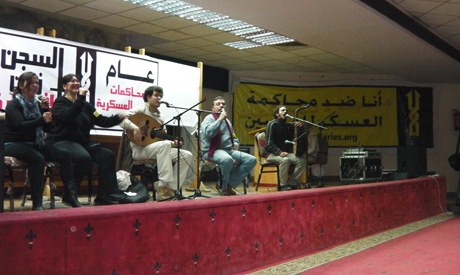
Eskendrella play at the close of the To Military Trials for Civilians press conference, on their anniversary
It's been one year since the night Amr El-Behairy, 32, was beaten by military personnel in front of Egypt's parliament building in downtown Cairo. He was later dragged out of a car, arrested, and sentenced to jail by a military court. Many others that night faced similar fates.
The same day, 26 February 2011, marked the launch of the "No to Military Trials for Civilians" campaign. On 24 March 2011, activists, human rights lawyers and families of detainees held their first group meeting at Cairo's Hisham Mubarak Law Centre. Today, the campaign boasts offices in the capital and Alexandria and conducts countrywide public-awareness campaigns.

The campaign advocates for the release of over 12,000 civilians, including minors, tried and sentenced by military courts in the absence of lawyers and witnesses – or the right to appeal. The conviction rate from these tribunals stands at 93 per cent, with 18 people having been sentenced to death, according to statistics provided late last year by military court head General Adel Morsy.

To date, official figures indicate that 2,613 detainees have so far been released. Finding accurate information about detainees or those facing trial, however, remains extremely difficult. Thousands of others, meanwhile, remain unaccounted for.

In October of last year, Field Marshal Hussein Tantawi, head of Egypt's ruling military council, announced a halt to the practice of referring civilians to military courts – with the notable exception of cases falling under Egypt's longstanding emergency laws. Many human rights activists, however, say the latter proviso renders the move meaningless.
The "No to Military Trials" campaign has been key to securing the release of numerous political detainees. El-Behairy, who was sentenced to five years in jail for attacking military personnel, became an icon of the campaign and Egypt's revolutionary movement. Last week, after almost a full year of campaigning on his behalf, El-Behairy was finally released by authorities.

On Sunday night, the "No to Military Trials" campaign marked its one-year anniversary with a press conference and concert at the Egyptian Journalists Syndicate. Families of those who remain in jail, released prisoners, and victims of abuse by the state all spoke at the event.
Among them was Samira Ibrahim, 25, who sued the government after being subjected to a forced virginity test by an army officer in March of last year. Rasha Abdel Rahman, another virginity-test victim and a witness in Ibrahim's case, announced that she, too, would be filing a complaint, drawing a standing ovation from those in attendance.
Rasha Azab, a well known journalist and activist detained on the same day as Ibrahim, also spoke about her arrest by authorities for broaching the issue in print.

The sister of detainee Mohamed Khaled, sentenced to three years in a military prison in Fayoum, said that she couldn’t recognise her brother when she paid him a visit because he had been so badly tortured.
Some people had even been tortured to death and buried in the desert, said recently-released detainee Abul Maaty. He says he was tortured continuously for four days after being detained in February of last year.
The brother of Essam Atta, 24, who, according to his family was tortured to death while in military detention, spoke about how the official medical report had said that his brother had died of a drug overdose. “We haven’t been able to investigate my brother’s death,” he said, verging on tears.
Mostafa Mohamed El-Ghareeb, a man in his 40s who was slapped with a jail sentence because the military thought he was somebody else, described how he had been stripped and beaten despite having a serious heart condition.

After each person spoke, the room erupted in spontaneous chants against the government and the ruling military council.

Military trial victim Alaa Abd El-Fattah, the renowned blogger detained for over a month by the army for refusing to accept the military court's legitimacy, also attended the event. He was accompanied by his activist wife Manal and mother Laila Soueif, who herself went on hunger strike to demand her son's release.

Ahmed Harrara, the 31-year-old dentist who lost both eyes to birdshot fired by Egyptian security forces, was likewise welcomed to the event with hearty applause.

"It was important to see many of the victims, but we have a long struggle ahead of us," said Maha Maamoun of the "No to Military Trials" campaign. "We're currently working on a new constitution. We’re also working on a draft law to change the articles of Egyptian military law that refer to civilians."

Alongside the release of El-Behairy, the "No to Military Trials" campaign was also recently able to celebrate activist Maikel Nabil's release from jail. The Egyptian blogger was sentenced to jail in March of last year for writing a blog critical of the ruling military council. Nabil withstood a 130-day hunger strike to protest his detention that led to his eventual release in January.

The evening concluded with a performance by revolutionary band Eskenderella, whose song Segn El-Alaa – "The citadel Prison" – is dedicated to those facing military trials.

Rappers in Egypt: A growing community
While rap as a genre has not yet reached mainstream Egyptian audiences, the hip-hop subculture is thriving
Menna Taher, Monday 27 Feb 2012

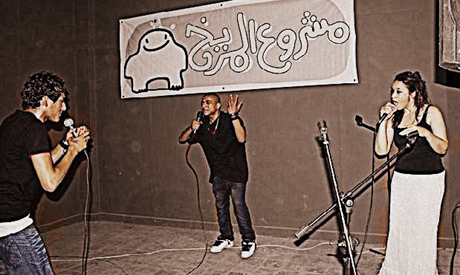
Black devils family
Black devils family performing in an open-mic night
The community of the Egyptian rappers is one of the growing subcultures in Cairo that have taken on a character of their own.

Omar El-Shamei, who is currently making a documentary about Egyptian rappers and is a rapper himself, talked to Ahram Online about the community.

"They’re all very young, and some are exceptionally good at what they do." El-Shamei explained that a lot of groups come from the Shubra district and rap everywhere; on the streets, in cafes, and in Cairo University.

Each has their own nickname, and some do not even know each other's real names.
Some of the names are Egyptian like Dawsha (noise), while others are foreign like Scratchy, Joker or Mr. Folly. But the rap community in Egypt has its own identity.

"The scene in Egypt also has created its own definitions and terms," El-Shamei said "and each group has a very young member that is still learning the art, like an apprentice."

Rappers in Egypt define the different genres as old school, new school, hardcore rap, flipflop, gang and crank. In old school style, certain words are emphasised; the new school style is faster and resembles the style of American rapper Lil Wayne, while crank depends on harmony. 
Hardcore rap takes a slower flow with a more aggressive tone, and gang uses themes of violent street life. "There’s a lot of free spirit," said El-Shamei, "but it’s going to be commercialised soon."
El-Shamei used the example of an event that took place in Tahrir Lounge in Goethe Institute, where rappers were hosted to perform.

"The event had nothing to do with the rappers," El-Shamei said. "It was an event on the launch of a website."

"They ended up taking over the whole show," he recalled. "They break-danced in the hall and rapped outside Goethe. They’re very aware of being energetic in live performances."

"Rapping has become our life," said the rapper Youssef Altay, perched on a car nearby the El Sawy cultural centre.

"There was a time when we used to come here and find everyone," the rapper Dawsha said - referring to the street located by El Sawy Culturewheel.

However, rappers are not widely known in Egypt, despite the growing scene. In concerts, usually other rappers or friends represent majority of the audience.

There are only a few well-known rappers that have made it to the studios – names like MTM, one of the very first bands in the scene, and rap trio Arabian Knightz (Rush, Sphinx and E-Money), who were established in 2006. Another rapper, Ahmed Mekky, has become known very quickly, which many explain by referencing his already-established popularity as an actor. 

The competition of the scene is high and some of the rappers take it very seriously, whereas some rappers are currently hoping to institutionalise the art.

Bel Araby, a project that was launched four years ago, includes rappers, designers, producers and distributors. It also has an institute to teach newcomers to the scene how to rap.

Black Devils Family is a group of hip-hop artists who call themselves a nation. For rappers, a nation includes rappers, break dancers and beat box artists. The nation of Black Devils Family includes four girls and four guys.

Lil Garhy, one of the members of Black Devils Family, says that he prefers to listen to rai music although rap is his favourite style of music to make.

"One of the most important rules for rappers is to write our own music," he said. "We also put a lot of emphasis on the show and have band T-shirts for each concert."

"We also like to include rap in protests," he said, while adding that the revolution has changed the inclination of the band and the themes of its lyrics. "In one of the marches to Tahrir Square we rapped and sung the soundtrack of the film El-Barea (The Innocent)," Garhy reveals.
"We also organised a protest in collaboration with [cultural initiative] Mashrou El-Mareekh, where a rope was held all the way from the Opera House to Tahrir Square," he said. "For us that symbolised the thread of thought that connects people."

Since hip-hop as a culture has its own political undertones and represents the voice of the oppressed, it is not surprising that it has emerged forcefully in countries in the Middle East, especially Palestine, in which rap has become one form of resistance.  

Tunisian rapper Hamada Ben-Amor was detained for three days in January last year, during the protests that led to the ousting of then-president Ben Ali.

According to Reuters, Ben-Amor, who is better known in Tunisian cyberspace as "The General," created a song about the problems of youth unemployment, the focus of much of the unrest that led to the uprising.

In Senegal, youth have created a dissident rapper community called Fed Up, who held protests against a third term candidacy of the president Abdoulaye Wade.

In Egypt, the scene is still in an embryonic stage, although it is developing fast, and the energy of young Egyptian rappers seems interminable.

Check out some of the music below: 

Youth revolt in Microphone (old review)


It is strange seeing this review from 2010 now, knowing that the dissent and underground depicted in this film is the very source of the ongoing revolution in Egypt today.


Microphone caused quite a stir at this year’s Cairo International Film Festival. Not only did it win the award for best Arab film, but was commended by several award recipients at the ceremony
Menna Taher, Saturday 11 Dec 2010


6 / 13
Gallery


Microphone is fresh and rebellious, depicting youths who always manage to find a way to create art, 
despite serious oppression from the state and their families. Artists, who can’t get an exhibition space, 
use the walls as their canvasses and the all-girl metal band, Mascara, play music despite their parents’ disapproval.


Like Ahmed Abdalla’s debut feature film, HeliopolisMicrophone alternates between documentary and 
fiction, as it follows two film students Salma (Yousra El Lozy) and Magdy (Ahmed Magdy), who are 
making a documentary about Alexandria’s budding underground art scene.


Khaled (Khaled Abou El Naga), who has just returned from the US, is also drawn to the underground 
music scene and tries to help them find a venue to hold a concert after they have been shunned from performing at the National Centre for Arts. The official at the centre deemed the songs presented as too
 bold in their criticism of the regime and the graffiti on the street as eye pollution to which Khaled replies,
 “So what about the election posters.  Isn’tthat eye pollution?” This timely retort hit the right spot and 
received fervent applause during the screening of the film at the CIFF.


Yet despite the opposition the artists faced, the music in the film never stops. It seeps into headphones,
studios, apartments and the streets. Music is everywhere, from rap and hip hop, to rock, to more jazzy 
or oriental tunes.


Massar Egbary, a band also featured in Ibrahim El Batout’s, Hawi, was one of the highlights in the film. 
Their songs fit both the mood and their lyrics expressed the sentiments of the film’s themes. 


 The playful ever-moving camera mirrors the Alexandrian youths it represents, who are in constant 
motion roaming about the city on skateboards, running or walking, yet never in cars. The freedom in
 movement seen in this film is in stark contrast to Heliopolis, with the deadening traffic of Cairo.


Abdalla is quite masterful in depicting a city and its spirit. Along with the stories presented, he weaves 
footage of the city and its ordinary citizens going about their daily lives.


One interesting story was of a man, who spends the whole day selling cassette tapes, and whose only interlude is adjusting a poster of an election candidate next to his booth. Sometimes he wipes off koshary (a popular Egyptian dish) thrown on it, at other times he decorates it with lights, or draws glasses on the candidate’s face when the lights burn his eyes.


This can be traced to a police officer in Heliopolis whose highlight of the day was stroking a dog and 
feeding him. The story worked well because of its silent tone, something that Abdalla has mastered.


In telling a story through visuals Abdalla succeeds, it’s only when the script takes dominance, problems 
occur. The weakest part of the film was the script, which needed more development. Though it was 
mainly about the Alexandrian artists, it focused on those making the film and their failed love stories, like 
Khaled’s unrequited love for his past lover, Hadeer (Menna Shalaby) and the relationship between 
Salma and Magdy.


The film included snippets of a conversation between Khaled and Hadeer, something that didn’t add 
much to the film. The unnecessary dialogue may have been acceptable. if it had been more interesting.


There was a lot more to the lives of the Alexandrian artists presented that was only mentioned briefly. 
An elaboration on their lives was much needed. Perhaps if Ahmed Abdalla had listened to Salma when 
she told Magdy, “the film is not about us,” while shooting her for their documentary, this pitfall wouldn’t have occurred.


Yet the film’s deficiency in presenting a comprehensive storyline didn’t affect the film’s purpose, the 
dire need to rebel and find ways out despite restraints. The youths in the film would wear masks to stay anonymous musicians or jump out of a window aided by friends to escape unpleasant situations at 
home. It’s this spirit that complements the film.


Microphone will be commercially screened in cinemas.

Egyptian music historian Antari dies
The prominent Egyptian music historian of the second half of the 20th century, Farag El-Antari, died on Tuesday 28 February - at age 83
Ahram Online, Wednesday 29 Feb 2012

News of the death of Farag El-Antari, music historian critic, has spread sadness in many quarters since
the morning of Wednesday, 29 February. Antari, who was 83, is best-known for his contribution to
Egyptian music history in the second half of the twentieth century – championing Eastern (Arabic) singing
and work by the 1970s oppositional composer Sheikh Imam Issa.

Writing in Al- KawakebAl-Hilal and Al-Qahira, among others, he was among the earliest critics to
formulate the notion of the popular musician who expresses and embodies public consciousness. One
long battle involved calling for the protection of the Arab musical heritage – the Sinai Bedouin music,
especially – against Israeli sabotage.He wrote at length about methods of collecting and preserving music.

Antari began his career as a volunteer musician during as a Military Academy student in 1957, then he received a Diploma in Theatrical Music from the Higher Institute of Music.

Following his graduation, he worked as an inspector at the Cairo Symphony Orchestra, then a supervisor
of the technical department. His works include "The Greek Roots of Our Music", "Singing in Egypt:
1852-1980", "Egyptian Musical Instruments from the Dawn of History", "The Zionist Robbery of Arabic
Music", "The Quran of Egypt", and "Abdel Halim Hafez: An Era of Beautiful Singing".

Project Begun on the Role of the Arts in the Arab Spring

It has been such a long time since my last post, and much has happened. Last August I discovered the work of Sultan Barakat, director of the Post-conflict Reconstruction and Development Unit and the University of York. In particular, I was interested to read about his meeting with the Royal Geographical Society with the Institute of British Geographers nearly ten years ago, the proceeds of which are located here. In it he mentions the current problems with reconstruction and development initiatives, namely, that they tend to focus almost exclusively on state and economy which does not deal with underlying cultural issues which may have caused the original conflict. This lack of cultural development hindered progress, in Barakat's opinion. He never overtly mentions music or the arts, but the way he was discussing culture he might as well have. Since he is only in York and I am in Leeds, I pay him a visit, thinking it is always good to network, but not thinking anything concrete would come of it. After a pleasant half an hour, Barakat (although by this time we are on a first name basis) presents me with a proposal he has written on request from the British Council for research into the role of the arts in the Arab Spring. He says that there is nothing mentioned at present about music in this report, but perhaps I should write that in. Without hesitation, perhaps the last time in this enterprise that I did not hesitate, I agreed. It was such a perfect fit considering my research area. That was the last I heard about it for quite some time, which was really very disappointing, but it gave me time to continue writing up my thesis, which I continued to do throughout the autumn.

Near the end of October, I get a message from the PRDU inviting me to a meeting with the British Council regarding the proposal I helped out with. This meeting was very interesting: the British Council were very excited about the project and were imagining that, if this project was successful, they could roll out similar projects all over the world. The proposal needed some tweaks, however, which I did quickly before my half-term family holiday, but, again, that was the last I heard for quite some time. I began to think it was never going to happen.

Anyway, it did. Eventually. At the start of December I was informed that I was to go to Egypt for two weeks in less than a week to begin field work. If I had been ten years younger with no dependants, I might have jumped, but it was impossible for me, but the project began anyway, although I have as yet not done any field work, rather working from home or York, collating data and organising the field work placements. So far the project has collected data from Egypt and Morocco and soon I, yes I, will be going to Tunisia, and the rest of the team will later go to Libya. The purpose of the project is to attempt to understand how the arts and social change affect each other and what role, if any, has the British Council and other international institutions played. In addition, the British Council were keen to know what they might be able to do in the future in these situations. Very exciting. It is too early to discuss the findings yet, but so far there is little evidence to contest my theories on the nature of music and conflict espoused elsewhere on this blog. All very promising! In the meantime, I have had to take an official break from the PhD, even though I was only a couple of months short of submitting a draft.

The project is due to end in mid-June, but there is talk about a public dissemination phase, which would presumably include radio, national press, popular journals, websites and possibly even television. That would be exciting to be part of that, but we shall see.

Meanwhile, I will begin sharing some of the links I have been discovering.

Thursday, 21 July 2011

A Night in Tahrir Square

I'm going to this tomorrow evening in London. It sounds very interesting and I have heard about a new research project linked to this. More TBA...


A Night in Tahrir Square

Featuring El Tanbura, Azza Balba, Mustafa Said and Ramy Essam

22 July 2011 / 19:30
Barbican Hall

Tickets: £12.50 - £25
subject to availability


Description  /  Press  /  Bio  /  FreeStage  /  Amnesty UK campaigns


It was the biggest party in Egypt’s history. Between January 25th and February 11th, the people turned Cairo’s Tahrir Square into a cross between Woodstock and a giant soapbox. Music and poetry played a crucial role in breaking the ice and melting the fear of tyrannical decades.

The Barbican is proud to celebrate people power in the Arab world with an exceptional line-up of artists, all of whom helped to create the soundtrack to Egypt’s revolution.


Listen to Zakaria Ibrahim from El Tanbura in our Blaze podcast

El Tanbura - 25 Jan, Tahrir Square

Singer-songwriter Ramy Essam went to join the protestors with his guitar as soon as the uprising started. He became 'the Billy Bragg of Tahrir Square', performing countless times a day on makeshift stages and living down in the square for the entire revolution. His song 'Irhal' ('Leave') became the anthem of the revolt and a huge viral hit on the internet. Egypt’s most famous street music ensemble, El Tanbura, were also Tahrir regulars and their percussion and simsimiyya-driven sound from Suez found great favour with the protestors. 'You cannot imagine the feeling of solidarity between all the people there,' says founder Zakaria Ibrahim.

Ramy Essam - "Leave" live in Tahrir Square

Another fêted presence in the square was that of Egypt’s greatest living poet Ahmed Fouad Negm. Negm has spent 18 of his 82 years in Egyptian jails for his outspoken and often bitingly comical poems and lyrics. He is unable to travel, but his former wife Azza Balba – who has has also had a taste of Mubarak’s jails – will take part; a lifetime of protest lends a unique power to her performances of songs by Negm, Sheik Imam and others. Mustafa Said is an Egyptian singer, composer and virtuoso of the oud, or Arabic lute. His fiery performances during the revolution demonstrated his ability to combine refined instrumental skills and revolutionary passion to immense effect.

'An institution, both in their native Egypt and abroad.'Songlines 5* on El Tanbura's Friends of Bamboute