Showing posts with label hip hop. Show all posts

Tuesday, 6 March 2012


Controversial Tunisian Rapper Arrested in Unclear Circumstances

 | 27 January 2012 2 Comments

Tunisian rapper, Anis Mrabti
Anis Mrabti, a young Tunisian rapper better known by his stage name Volcanis, was arrested at his house on January 25th.
Statements made by Mrabti’s father after the incident, coupled with the political nature of Mrabti’s music, have provoked speculation about the motivations of the police action.
According to Anis’ father, Mongi Mrabti, six men in plain clothes broke into the family house, asked for Anis, arrested him, and confiscated his desktop and MP3 player. The father asked them who they were and they answered that they were police.
“They drove a tinted glass civilian car and they did not show me any arrest warrant or any police ID,” explained the father.
In an interview with Tunisia Live, Mongi Mrabti stated that the Mrabti family was not told where there son had been taken and were not informed of what he had been charged with for nearly two days, until the family received a call from a Tunisian citizen not affiliated with the police who had heard of Anis’ story and made independent investigations. The phone call apparently informed them that Anis had tested positive for drug use, and that his arrest came after others involved in the same “drug case” had given police Anis’ name.
Anis Mrabti became well known recently for his song “Matbadal Chay” (“Nothing has changed” in Tunisian Arabic), which contains sharp criticism of the current political situation in Tunisia. In the song, Mrabti criticizes the Tunisian government, accusing Tunisian politicians of running after power and speaking about the suffering of Tunisian people from bribery and social injustice. The controversial nature of the song has prompted some on social networks to speculate that Mrabti has been arrested for political reasons.
Anis’s father said some human rights organizations contacted him and told him that they will look into the allegation that Anis was arrested without warrant or due process.
The Ministry of the Interior released a statement on its official Facebook page in which they denied all rumors about the arrest being politically motivated, or having anything to do with the lyrics of Mrabti’s song.
This morning, Mongi Mrabti received a call from the police station of Wardiya, a suburb of Tunis asking him to collect his son’s desktop. He has been told that his son will be tried tomorrow in a drug case in Grombalia, in the governorate of Nabeul, the alleged crime said to have taken place in Hamamet, also in the Nabeul governorate.

Rappers in Egypt: A growing community
While rap as a genre has not yet reached mainstream Egyptian audiences, the hip-hop subculture is thriving
Menna Taher, Monday 27 Feb 2012

Black devils family
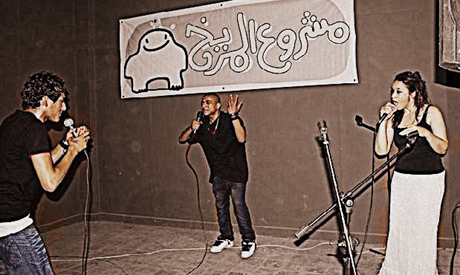
Black devils family performing in an open-mic night
The community of the Egyptian rappers is one of the growing subcultures in Cairo that have taken on a character of their own.

Omar El-Shamei, who is currently making a documentary about Egyptian rappers and is a rapper himself, talked to Ahram Online about the community.

"They’re all very young, and some are exceptionally good at what they do." El-Shamei explained that a lot of groups come from the Shubra district and rap everywhere; on the streets, in cafes, and in Cairo University.

Each has their own nickname, and some do not even know each other's real names.
Some of the names are Egyptian like Dawsha (noise), while others are foreign like Scratchy, Joker or Mr. Folly. But the rap community in Egypt has its own identity.

"The scene in Egypt also has created its own definitions and terms," El-Shamei said "and each group has a very young member that is still learning the art, like an apprentice."

Rappers in Egypt define the different genres as old school, new school, hardcore rap, flipflop, gang and crank. In old school style, certain words are emphasised; the new school style is faster and resembles the style of American rapper Lil Wayne, while crank depends on harmony. 
Hardcore rap takes a slower flow with a more aggressive tone, and gang uses themes of violent street life. "There’s a lot of free spirit," said El-Shamei, "but it’s going to be commercialised soon."
El-Shamei used the example of an event that took place in Tahrir Lounge in Goethe Institute, where rappers were hosted to perform.

"The event had nothing to do with the rappers," El-Shamei said. "It was an event on the launch of a website."

"They ended up taking over the whole show," he recalled. "They break-danced in the hall and rapped outside Goethe. They’re very aware of being energetic in live performances."

"Rapping has become our life," said the rapper Youssef Altay, perched on a car nearby the El Sawy cultural centre.

"There was a time when we used to come here and find everyone," the rapper Dawsha said - referring to the street located by El Sawy Culturewheel.

However, rappers are not widely known in Egypt, despite the growing scene. In concerts, usually other rappers or friends represent majority of the audience.

There are only a few well-known rappers that have made it to the studios – names like MTM, one of the very first bands in the scene, and rap trio Arabian Knightz (Rush, Sphinx and E-Money), who were established in 2006. Another rapper, Ahmed Mekky, has become known very quickly, which many explain by referencing his already-established popularity as an actor. 

The competition of the scene is high and some of the rappers take it very seriously, whereas some rappers are currently hoping to institutionalise the art.

Bel Araby, a project that was launched four years ago, includes rappers, designers, producers and distributors. It also has an institute to teach newcomers to the scene how to rap.

Black Devils Family is a group of hip-hop artists who call themselves a nation. For rappers, a nation includes rappers, break dancers and beat box artists. The nation of Black Devils Family includes four girls and four guys.

Lil Garhy, one of the members of Black Devils Family, says that he prefers to listen to rai music although rap is his favourite style of music to make.

"One of the most important rules for rappers is to write our own music," he said. "We also put a lot of emphasis on the show and have band T-shirts for each concert."

"We also like to include rap in protests," he said, while adding that the revolution has changed the inclination of the band and the themes of its lyrics. "In one of the marches to Tahrir Square we rapped and sung the soundtrack of the film El-Barea (The Innocent)," Garhy reveals.
"We also organised a protest in collaboration with [cultural initiative] Mashrou El-Mareekh, where a rope was held all the way from the Opera House to Tahrir Square," he said. "For us that symbolised the thread of thought that connects people."

Since hip-hop as a culture has its own political undertones and represents the voice of the oppressed, it is not surprising that it has emerged forcefully in countries in the Middle East, especially Palestine, in which rap has become one form of resistance.  

Tunisian rapper Hamada Ben-Amor was detained for three days in January last year, during the protests that led to the ousting of then-president Ben Ali.

According to Reuters, Ben-Amor, who is better known in Tunisian cyberspace as "The General," created a song about the problems of youth unemployment, the focus of much of the unrest that led to the uprising.

In Senegal, youth have created a dissident rapper community called Fed Up, who held protests against a third term candidacy of the president Abdoulaye Wade.

In Egypt, the scene is still in an embryonic stage, although it is developing fast, and the energy of young Egyptian rappers seems interminable.

Check out some of the music below: 

Wednesday, 13 October 2010

ESA: Arts Branch - Conference @ University of Surrey, Guildford

In early September I presented at my first conference, the European Sociological Association - Arts Branch Midterm Conference at the University of Surrey, Guildford, UK. I think it went rather well. I'm now looking at places to publish the paper, but in the meantime here is the abstract:

Music as a Reflexive Process in Conflict Transformation Settings
Can music play a role in positive conflict transformation? Based on an examination of secondary sources that have addressed the contrasting musical conflict transformation projects of the West-Eastern Divan Orchestra and Hip Hop and primary data collected from Pontanima, an inter-religious choir in Sarajevo, Bosnia-Hercegovina with an explicit conflict transformation remit, it appears that the response to this question is either negative or at least not wholly positive. Some commentators have suggested that music is no better equipped to positively deal with conflict than any other social activity and that it is only the belief that it can that drives such projects. Likewise, recent publications on the topic have done nothing to suggest that music is particularly effective in this manner, despite claims to the contrary from some of these authors. This paper will argue that it is this very belief in the power of music that is essential for understanding why such projects continue to proliferate despite evidence to suggest they are not effective and how a future successful project might be conceived. This paper will attempt to illustrate the reflexive process that links music to our concepts of personal and cultural identity, memory, emotion, beliefs and behaviour. Primary and secondary sources will be drawn upon to illustrate this process and how it could be applied to conflict transformation scenarios.