Showing posts with label power. Show all posts

Friday, 18 November 2016

Music, Power and Liberty: Book is out now!

Olivier Urbain and I edited this book which came out of a conference on music and peacebuilding in Paris a few years ago. Here is the abstract and a link:
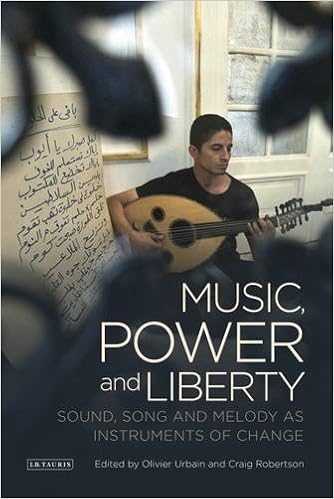
Music is a complex and multi-faceted art form. Yet too often it is regarded as discrete and self-contained. The chapters in this groundbreaking book explore different aspects of how music may shape society and culture, yet go much further in viewing musical activity as a mode of power that can transform the lives of communities and individuals. The contributors (who include sociologists, musicologists and performers) focus above all on the relationship between music and the political upheavals of the Arab Spring. They examine key topics like music and revolution in Tunisia; the Egyptian musical tradition of the Revolutionary Song; and the ambivalent social status of the Arab musician, revered by the public when performing but also facing suspicion in a society where music is rightly seen as dangerous and subversive. In showing how music has been used to challenge the status quo, as well as enforce it, the ambiguity of music is fully revealed: it can be used to bolster both regime power and popular liberty, often simultaneously. This is a vital contribution to more nuanced understandings of music and politics.


https://www.amazon.co.uk/Music-Power-Liberty-Instruments-Institute/dp/1784534447

Tuesday, 6 March 2012

Toda Institute Music, Power and Liberty Conference


In early February this year I presented at the Toda Institute's Music, Power and Liberty Conference in Paris. The Toda Institute is infamous in my mind for publishing the first academic book on the subject of Music and Conflict Transformation entitled, funnily enough, Music and Conflict Transformation, edited by the director of the institute, Olivier Urbain. Due to the leading nature of such a publication I have naturally analysed pretty much every page in depth and I unfortunately found it generally wanting in terms of empirical and theoretical rigour or practical application. So it was with some trepidation that I accepted the invitation for this conference. I am happy to report that my fears were unfounded. I found the papers presented at conference stimulating, utterly relevant, and the approaches significantly more grounded and realistic than in the previous 2008 publication. There is a slight danger of perhaps too much cynicism, but there still seems to be enough drive and optimism to keep the momentum going.
The papers presented in Paris will eventually make their way into a book to follow the original Music and Conflict Transformation book, and since I will most likely be involved in this project to one degree or another, I will not comment on each paper just yet. Suffice it to say for now that there were three broad categories that were addressed:

1) Music, Power and Social Change: Music has been actively engaged with in the socio-cultural arena to influence the status quo; either to keep it static or to challenge and overturn it. There were many presenters from North Africa and their talks were completely resonant with my current research on the role of the arts in the Arab Spring.

2) Unification versus Censorship: There is the age old battle of using music as a tool of expressing togetherness and/or fostering social unification versus powers that would rather keep people apart, usually for social control purposes. There is also the continued battle between the romantics and the realists.

3) How music influences belief systems through education and technology: Increasingly researchers are talking about belief and how this is a key factor in behaviour and also how music and education influence belief. More recently there have been studies on how music and education is transmitted via social media and other technological platforms, thus effectively spreading belief.