Showing posts with label music. Show all posts

Monday, 27 March 2017

Peace, Empathy and Conciliation Through Music Event

This sounds like a very interesting event in Australia in September. Featuring a keynote by Laura Hassler, the director of Musicians Without Borders, whom I met in Bogota last year.


Date: 21-22 September 2017
Venue: The University of Melbourne, Parkville VIC 3052
Submission Deadline: Thursday 1 June 2017
Event Registration Deadline: Saturday 1 July 2017
Enquiries: Samantha Dieckmann (samantha.dieckmann@unimelb.edu.au)
Organised by the ARC Centre of Excellence for the History of Emotions, The University of Melbourne, in collaboration with the Faculty of the Victorian College of the Arts & Melbourne Conservatorium of Music, and Multicultural Arts Victoria, this collaboratory will bring together researchers, practitioners (musicians including performers, community musicians, music educators, music therapists; community development workers; social service workers; arts organisation delegates), and arts and community policymakers to share ideas around the ways that music is used to develop peace, empathy and conciliation. We invite submissions from local, national and international researchers and practitioners, and hope that the symposium will produce thought-provoking discussion and fruitful partnerships between industry, community and education sectors.

Organised around the United Nations International Day of Peace, this collaboratory will include a keynote address by Laura Hassler, founder and director of ‘Musicians Without Borders’.

Wednesday, 30 November 2016

Music and Beyond Intractability

I have long used the excellent Beyond Intractability resource on peacebuilding. It has informed my understanding of conflict and peace processes and it is organised so effectively that I have been thinking about this format for the Min-On Music Research Institute website. So I was surprised that I missed the article The Processes of Music and Peacebuilding by Allie Adelman from 2011 on this very site.
Adelman refers to many of the available writings on the subject, which were not many at that time.She  draws heavily upon Urbain's first edited volume on the subject, Music and Conflict Transformation. As many of you know, this was not only the subject of my PhD thesis, I now work closely with Olivier Urbain at the Min-On Music Research Institute and we have since published a follow up book Music, Power and Liberty. While she does briefly mention that music can just as easily (or more easily) be used for destructive purposes, she focuses on the positive potentials. To this effect, there is an over-reliance on either anecdotes from famous people, like Nelson Mandela, or broad sweeping statements attesting to the power of music with very little evidence provided. Adelman even refers to Pontanima, the choir that I researched and took part in during my PhD. She does not go very far to explain what was really happening within the musical experience itself or what specifically these experiences changed and how.
Adelman concludes with another broad claim for the power of music, referring to Lederach's influential The Moral Imagination. This book, and Lederarch, was an inspiration for myself as well, but even within that book there are broad unsubstantiated claims made on the behalf of the power of music. This article is a useful introduction to some of original writings on the subject of music and peacebuilding, but considering how useful the rest of the site is, I strongly believe that this needs some serious updating with more current scholarship and a much more thorough empirical approach. In addition, more practical applications and models would also be useful, as would methods of evaluation. Otherwise, music might will continue to be believed to function powerfully in peacebuilding projects with no ability to back these beliefs up to stakeholders or measure the outcomes. This, in turn, could damage the whole concept and prevent future projects from ever being realised.

Friday, 18 November 2016

Musicological ethnography and peacebuilding

I've published this article recently in the Journal of Peace Education here:

Based on my PhD research with an inter-religious choir in Sarajevo, Bosnia Herzegovina, this paper discusses my interdisciplinary methodologies and suggests how this approach might be applied to future peacebuilding efforts. The use of ethnographic methods in research is an attempt to comprehend a social scene in a way that is as close as possible to the understanding of those within the scene. Normally, the data collected is linguistic in nature, although the visual and gestural, embodied data are increasingly included. There is very little consideration of the aural in this form of research. Even when the audio is considered, it is often described in written language rather than considered it to be data in and of itself, thereby creating a translation issue. In my own research in Sarajevo, I have made the case for sound and music as ethnographic data, since it is a means of experiencing and expressing tacit cultural understanding within and without a particular social group. This paper examines the commonalities between this approach and the peacebuilding strategies of Lederach et al. (http://www.beyondintractability.org/) and proposes how musicological ethnography might be useful as a tool for increased intercultural understanding in peacebuilding activities.

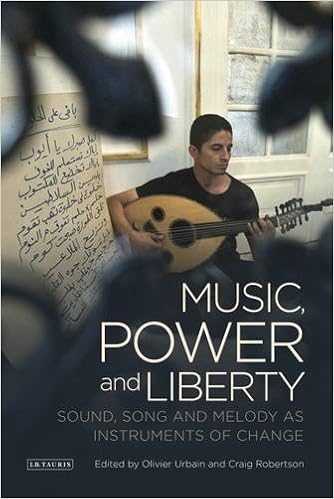
Music, Power and Liberty: Book is out now!

Olivier Urbain and I edited this book which came out of a conference on music and peacebuilding in Paris a few years ago. Here is the abstract and a link:

Music is a complex and multi-faceted art form. Yet too often it is regarded as discrete and self-contained. The chapters in this groundbreaking book explore different aspects of how music may shape society and culture, yet go much further in viewing musical activity as a mode of power that can transform the lives of communities and individuals. The contributors (who include sociologists, musicologists and performers) focus above all on the relationship between music and the political upheavals of the Arab Spring. They examine key topics like music and revolution in Tunisia; the Egyptian musical tradition of the Revolutionary Song; and the ambivalent social status of the Arab musician, revered by the public when performing but also facing suspicion in a society where music is rightly seen as dangerous and subversive. In showing how music has been used to challenge the status quo, as well as enforce it, the ambiguity of music is fully revealed: it can be used to bolster both regime power and popular liberty, often simultaneously. This is a vital contribution to more nuanced understandings of music and politics.


https://www.amazon.co.uk/Music-Power-Liberty-Instruments-Institute/dp/1784534447

Thursday, 21 May 2015

New Article in African Conflict and Peacebuilding Review

The latest African Conflict and Peacebuilding Review contains an article by myself. You can access it here through JSTOR:

Here is the abstract:

Whose Music, Whose Country? Music, Mobilization, and Social Change in North Africa

ABSTRACT Social change began to rapidly emerge in many North African states in 2011 and 2012, and this process continues today. Music has been embedded within this process from the beginning and has been a key feature in street protests and expressing group identity that opposed the status quo at the time. The situation has since become extremely complex as group identities have split and merged, but in the early days of social change in Egypt, Tunisia, and Libya, music was used by professional and amateur musicians as well as non-musicians for several purposes, namely, to express a more generalized group identity, to capture the moment of the protests, and to propagate information about the situation to a wider Arab diaspora and gain support from them. Conversely, the state also used music at this time as a form of social control by promoting music that was uncritical to marginalize the challenging music.

New Music and Conflict Transformation PhD

A new PhD programme has been started up at Queens University, Belfast. The details are below. Olivier Urbain of the Toda Institute will be guest lecturing there this autumn. Who knows, maybe I'll get to do something there sometime soon!


"Musical Crossings: Music Mediation in Conflict Transformation"

Supervisors:
Professor Fiona Magowan (School of History and Anthropology and ISCTSJ Research Fellow); Professor Pedro Rebelo (Creative Arts, Music)
This project considers the ways in which music mediation has developed as a means of supporting and engaging the experiences of those who have lost relatives or who have been the victims of traumatic events in post-conflict regions. This doctoral research invites applicants to explore how musical practices facilitate new kinds of exchange, dialogue and relationships between communities and individuals who may not otherwise meet. Through analyses of music mediation processes with non-governmental and community-based organisations in Europe or South America, the project considers how music facilitates physical, emotional and psychological change among those who have experienced political conflict and violence.
Extending recent scholarship around the effects of music in conflict resolution, applicants are asked to consider the following questions:
  • How do community-facilitated music mediation programmes empower individuals and communities to support and effect interpersonal change?
  • How do different musical repertoires shape participants’ memories, narratives and experiences of conflict?
  • To what extent do communally-organised musical experiences mediate attitudes and behaviours in everyday socio-political decision-making?
  • In what ways is music mediation creating a legacy of conflict transformation in post-conflict regions?
Research on music and peacebuilding has considered how the interpersonal aesthetics of musical practice can enhance dialogue and strengthen relationships by increasing empathy, mutuality and creativity in participation. Further research is needed to understand how post-conflict musical mediation can change victims’ attitudes towards conflict and the specificities of local politics, as musical facilitators seek to empower communities and create sustainable peacebuilding activities among the next generation.
Closing Date for Applications: 27 February 2015
For further information on the PhD project, please contact: Prof. Fiona Magowan (f.magowan@qub.ac.uk). For advice on the application process and eligibity for funding, please contact Susan Templeton (s.templeton@qub.ac.uk). Additional information is available at:

Wednesday, 7 May 2014

Witness - Dr Sarmast's Music School


This is a very interesting documentary about the establishment of the Afghani National Institute of Music after the Taliban effectively destroyed music culture in Afghanistan. Media outlets such as Al Jazeera have reported positively about the school and the documentary, but I'm curious as to why John Baily from Goldsmiths College was not mentioned, since I believed that he was rather crucial in the resurrection of Afghani musical culture after the fall of the Taliban, as expressed in this article.  I am also disappointed, but not surprised, that there was little debate about the pros and cons of official musical institutions, their role in state-sanctioned identity-building and there relationship and responsibility to the average citizen.

Tuesday, 6 May 2014

Music Intervention

I've just come across this wonderful blog by Shoshana Gottesman, a musician activist and educator, called Music Intervention: http://musicintervention.wordpress.com. It's is a great resource for exactly the kinds of things I've been discussing on this blog. Shoshana has been quite a bit more active on her blog, however. She does have a link to this blog, which is nice. She focuses on 'glocal' music interventions, which as it sounds, entails local grassroots activism organised on a global network. There are links to other relevant blogs, many useful posts and a list of some existent music intervention projects. 

Monday, 5 May 2014

Music and Conflict Resolution Talk by Ian Ritchie

Ian Ritchie, the director of the City of London Festival, gave a talk on my subject it seems last year. Ritchie read Law and Music at Cambridge, which certainly gave him a solid basis for the topic of music conflict resolution. I have copied here the transcript of the talk held at Barnard's Inn Hall in April 2013:

I am talking today about music and conflict resolution.  Although there is considerable evidence available concerning the power of music and its effective application to the damaging human consequences of conflict, much less has been spoken or written about its potential role in resolving conflict or addressing its causes.  Without redressing the balance completely, I hope to provide one or two pointers in the wider context of music and its longstanding relationship with conflict.

There are a number of ideas that are worth exploring – separate subjects as well as variations upon the same – and I propose to say something about the power of music and to define some of the different facets of its relationship with conflict.  I hope that this will provide an overture of ideas: the full symphony has yet to be written.  In fact, we have only begun to scratch the surface of what is to be learned about the effects of music upon human emotions, behaviour and well-being, both mental and physical.

I have chosen the following themes and variations: conflict resolution at the heart of musical expression itself; the use of music to avert conflict, to resolve conflict, to heal the trauma caused by conflict and to rebuild broken communities, not just damaged minds; and finally music’s response to the experience of conflict, for example inspired by war, which incidentally can be part of the healing process or ‘resolution’ achieved through the creative process.  With the importance of ‘resolution’ uppermost in my mind, I have avoided the subject of music’s use throughout history as propaganda in support of conflict and as a weapon on the battlefield itself.

By way of introduction, I should explain how I came to be involved in this whole area of discussion.  In the first place my whole professional life has involved making and working with music, and over time I have gained a deepening awareness of the nature and power of music itself.  But then, around 20 years ago, I was drawn into the events and consequences of the war in the Balkans, especially in Bosnia-Herzegovina.  Some of you will remember the extraordinary courage of the cellist in Sarajevo, Vedran Smailović, who night after night donned his tails and played in the city’s main marketplace, at the site of the murderous mortar attack by the Serbian forces; it was freezing as well as dangerous but he survived, albeit with frostbite which damaged his cello playing. I knew some of the composers who wrote music specially for him and one in particular, Nigel Osborne, who was renting my flat in Edinburgh at the time: he visited Sarajevo in the midst of the siege and arranged to get the cellist out; he finally succeeded in bringing Vedran to Scotland where my flat became his home for a while!  At the end of the war I spent time in Mostar with Nigel Osborne setting up the Pavarotti Music Centre and its unique Music Therapy clinic for children suffering trauma as a result of the conflict: it was also a music school, recording studio, performance space and a centre for musical outreach into the schools and communities throughout the region; I also set up a cross-community orchestra, the Mostar Sinfonietta, which comprised not only Muslims and Catholics from the two parts of the divided city but also musicians of all standards and from all the confessions of this one-time mixed and integrated society.

Conflict resolution has lived at the heart of musical expression.  It is generally true to say that every artist is on a quest for beauty, though the 20th century threw up some exceptions to this rule.  In music, beauty stems from the creation of dissonance and its resolution into harmony, the struggle being required to create the conditions necessary for the greater expressive impact. This seems to offer a parallel with human nature itself which appears to require contradiction and disagreement en route to achieving the clarity of consensus and agreement – or, worse still, needs conflict to be waged in order properly to comprehend the peace that might ensue.  It is therefore unsurprising that music, a basic human impulse which predates even any form of speech in an individual’s development, is a potentially powerful medium in the area of conflict and a tool for its resolution.  The nature of music can be described as an interdependent triangular relationship between inventing, performing and listening – three cornerstones of a creative triangle.  There are illustrations which I can give of conflict being averted, resolved and its traumatic consequences repaired through all three modes of musical engagement: simply listening, performing with a voice or an instrument, or creating either in pure musical terms or harnessed to other forms of expression, such as words in the making of song.

There is one very public and increasingly widespread example of music being used to avert conflict: I am sure that many of you, like me, will have emerged from a London underground station or entered a shopping centre to the sound of classical music being played through loudspeakers.  The purpose of these installations is to discourage the build-up of restless individuals, to break-up the congregation of rowdy gangs and to prevent anti-social behaviour.  As a music lover, one is bound to feel slightly queasy at the thought of this instrumental function of a much-loved art form as a kind of subliminal wallpaper as opposed to food for the soul; and it is ironic that something beautiful should be deliberately off-putting rather than encouraging for people.  But it has the desired effect.  The potential of music to wind people up and foment conflict is well known and has been the bread and butter of military musicians for thousands of years – raising morale on the part of both attacker and defender, inspiring teamwork but also individual and collective aggression.  It follows that the exact opposite can also be achieved, with music that can inspire peace and dissolve aggression.  There is considerable potential for the Armed Forces to engage in this approach as part of the role of the very many military musicians deployed in the theatres of war and not merely on the parade grounds.  The role of army bandsmen in relation to medical care has existed for centuries and now goes well beyond the stretcher-bearing duties of the musicians, as was the case in both the World Wars for example, to embrace working in field hospitals alongside the doctors.  And now there are even graduates with formal music therapy qualifications who have started to enter the Army as serving musicians.   This is an optimistic sign of music being applied potentially more systematically as a cure to the trauma of military engagement, even though it does not yet foretell the possibility of music as prevention – and we must remember that prevention is better than cure, as the saying goes.

Although music and the resolution of conflict is the declared subject of my short talk, this is perhaps the most elusive aspect of music’s role in this context.  There is no doubt that it can have a calming influence.  Neuroscientists – and I am not equipped or prepared to speak with any pretence of expertise in this area – have demonstrated the actual patterns of brain activity in response to different kinds of music that can induce different emotional responses.  Indeed the physics and the chemistry induced by music within the human brain are becoming increasingly the subject of expert treatise and actual treatment in the fields of neuroscience, psychiatry and the growing profession of music therapy.  But these applications of music have tended to prove their cases in the aftermath of conflict rather than in the midst, addressing the traumatic effects or social damage within communities that have been divided through conflict.  One illustration that I shall give, one of a number of examples that I experienced during my many visits to Bosnia in the aftermath of the Balkan conflict, when I was engaged with the composer Nigel Osborne to set up and build a Music Therapy clinic in Mostar specifically to treat war-damaged children, is a social and political one.  After we had built and opened the Pavarotti Music Centre, complete with its Music Therapy clinic, a number of us continued to volunteer in delivering music projects for the children of Mostar as well as for the adults and for the specific goal of healing the society as well as the individual: this meant bringing people together from across the very strong divide between East Mostar and West Mostar – essentially the Moslem Bosniaks and the Catholic Croats who made up (and still comprise) the most substantial proportions of the city’s population; at the conclusion of a major songwriting and choral singing project involving children from both halves of the city, we presented a concert in the courtyard of the Music Centre to which the two Mayors of Mostar were invited to attend (officially there was only one Mayor and a deputy Mayor for the municipality, but the community division required the artifice of recognising two mayors to support the separate education systems and civic governance of the place); the Mayors sat at the opposite ends of the front row, surrounded by their respective weighty officials, but during the course of the evening they increasingly recognised their people, their families and their heritage in the faces, songs and behaviour of the children performing in front of them – by the end of the evening the two Mayors were sitting together and speaking animatedly for the first time since hostilities had ended.  Although the Serbo-Croat language is shared and spoken by the divided parties, it provided no medium for real understanding: it was the music that achieved that.

I can offer countless examples of music as a means of healing trauma caused by conflict, and the work in Bosnia is just one of these.  Colleagues of mine in various NGOs or working as individuals have found themselves working effectively as artists applying their gifts in ways that are therapeutic – in ex-Yugoslavia, the Caucasus, the Middle East and parts of Africa, for example, that have been torn apart by war – but the medically accredited clinical discipline of Music Therapy, now functioning all over the world, has been applied systematically to trauma in rather more isolated conflict situations.  Apart from the Bosnian example, another centre for this work has been Northern Ireland both during and in the aftermath of the troubles there.  From these and other sources have emerged conferences, publications and studies which have already been shared internationally and continue to show the way in which music can actually heal post-traumatic stress disorders.  This approach has massive untapped potential in relation to the Armed Forces, particularly as they return from the Afghanistan and Iraq theatres of war with many suffering from diagnosed post-traumatic stress disorders which, in earlier generations, were described as shell shock and consigned traumatised soldiers to forbidding asylums around the country.  In recent years there has been substantial work undertaken – in Northern Ireland once again – among civilians and the widespread incidence of trauma that people have experienced.  This has shown not only the individual benefits from this being treated, using Music Therapy as a powerful means, but also the collective consequences upon the wider community.  In short, the proposition now is that sustainable peace can be achieved far more readily through addressing and healing trauma within individuals, families, and their wider circles.

I have already alluded to how music can rebuild broken or divided communities and not just repair individually damaged minds.  During my time spent in Bosnia over the years, one particular model which I helped to develop and support was that of the Mostar Sinfonietta, which drew together once more the small number of musicians who remained in the city by the time the conflict was over.  This was not as straightforward as it sounds, because of the divided nature of the city: once upon a time this held a happily united and intermarried mixture of people of all confessions and national backgrounds, but 15 years ago it was (and to some extent still is today) a place of ghettos and political divisions, principally between the Moslem and Catholic communities.  The small mixed-ability ensemble of musicians symbolised a unity that could be achieved through a shared purpose and a common language – a harmonious resolution to the dissonant conflict which went before.  Daniel Barenboim, through his West Eastern Divan Orchestra made up mainly of young Israeli and Palestinian musicians, achieved a worldwide profile for this way of working together.  Less visibly, another organisation I am involved in, Musicians without Borders, has for several years been running a Rock School in Mitrovića, a town in Kosovo which has remained resolutely divided between its Albanian and Serbian citizens on opposite sides of the river running through.  The only way to bring the young people together was to take them on summer courses to Skopje in neighbouring Macedonia where they happily made music together, whilst back in Kosovo their School existed in two separate buildings on either bank of the river.  Soon they started to walk across the bridge and begin the process of their families and communities getting to know each other once again. Closer to home, Musicians without Borders, through its UK office in Manchester, has brought together refugees and asylum seekers, not only from different areas of conflict around the world but also those remaining separated in spite of coming from the same country: the effective medium for this has been music, leading to the creation of an inspiring multinational ensemble, Beating Wing Orchestra, and project involving victims of torture called Stone Flowers.

As I approach the conclusion of my words, it would be remiss of me not to refer to the huge amount of music and, indeed, of poetry which through song has become music that has been inspired by or created in response to conflict.  Perhaps more than in any other time of war, some remarkable soldier-composers emerged during the First World War, such as Butterworth, Gurney, Ravel and Vaughan Williams, alongside poets, painters and other famous artists.  Even music created by those who avoided taking part in wars, such as Second World War pacifists like Benjamin Britten or Samuel Barber, or composers who were too old to fight like Richard Strauss, responded to the pity of war in a way which could offer resolution, or a musical pathway to peace, at least in their own minds and routinely affecting those of the performers and the audiences of such music.  This summer I shall be presenting an experiment, hopefully a first which will be much imitated in the future, by commissioning special arrangements of some of this music, created by those involved in and influenced by conflict, so that it can be performed by military band.  In this instance, it will be the Band of the Royal Artillery who are of course trained and deployed in making music for ceremonial occasions and raising public morale: indeed, on the morning of their concert which happens to be on Armed Forces Day, 29th June, they will have changed the guard at Buckingham Palace; that evening, however, they will be performing a new and totally different repertory that includes the reflective and profoundly moving songs which Ivor Gurney wrote while in the trenches on the Somme. This concert concludes the Worlds in Collision conference which the City of London Festival is presenting in partnership with The Musical Brain.

In conclusion, I should tell you a little bit about this conference that looks at Music and the Trauma of War. We are putting it on in the Mansion House, symbolising the very heart of our capital City and bringing together musicians, music therapists, arts practitioners, psychologists, psychiatrists, neuroscientists, historians and soldiers to share their knowledge and experience.  The first day looks at the application of music to the trauma of war and the second at the response of music to the experience of conflict, ending with the unusual concert.  This event will hopefully offer some continuity – at least one of the potential directions forward – from this important seminar in which it has been a privilege to have the chance to participate and say a few words.  As I said at the start and have done little to disprove in my words which followed, we are only now scratching the surface of a huge subject and just beginning to understand the extent of music’s usefulness and its power to make a difference to individual lives and to humanity as a whole.


Tuesday, 22 October 2013

Trust me, I'm a doctor...

Yes, I can now call myself Dr. Robertson! I passed my viva on August 16, with Nick Prior from Edinburgh University as my external examiner and David Inglis as my internal. It is pending minor revisions, but that is to be expected. Here is a picture of me with my lovely doctor-cake, made in the Norwegian-style by the amazing Tia DeNora:


So now begins the long slog to find gainful employment that is at least somewhat related to music and conflict transformation. I think I came close a couple of times, but the market in the UK is pretty dire for 'soft' subjects like music and sociology, let alone new fields such as mine. All is not lost, however. I have made some great connections with the University of Leeds and I have put a bid in for a post-doctoral fellowship with the British Council to be hosted by both the Music Department and the Institute of Communications Studies at Leeds. I have also just applied for a research fellowship there as well. Meanwhile, I am still editing the upcoming book Music, Power and Liberty with Dr. Olivier Urbain from the Toda Institute, who have also kindly invited me to participate in the Asia Pacific Peace Research Association (APPRA) conference in Bangkok in November. I shall be presenting and co-hosting a special panel on the arts and non-violent conflict reduction along with Dr. Urbain and Daisuke Akimoto. I am also writing a chapter for a book to be published next year entitled Protests as Events: Events as Protests. Finally, an article that I wrote last year about the potential for music and conflict transformation has finally been accepted by Poetics, although I need to make some changes which will not be published until next year as well.

More updates from around the world soon.

Thursday, 6 June 2013

Music Above Fighting

As with most music and conflict transformation initiatives that I come across, I was excited when I started watching the mini-documentary Music Above Fighting. Based in three conflicted areas separated physically by walls or partitions (Northern Ireland, Israel/Palestine, India/Pakistan), the documentary shows musicians on either side playing with each other across the border. There was one line in particular from an elderly tabla player on the Indian/Pakistani border that struck me: "Only in death and music can I cross the border." I thought this had real potential. I was very disappointed to then discover that they were all just singing and playing "Imagine" by John Lennon. I don't have anything against the song exactly, but songs for peace don't actually change anything. Increased dialogue through music across physical barriers, in spite of the barriers, no that would be inspiring. A missed opportunity.


Long Time - The State of Things in Music and Conflict Transformation

It has been a very long time since I posted anything on this blog, for which I am mightily sorry. I have not been idle, though. I have finally submitted my PhD thesis entitled "Singing to be Normal: Tracing the Behavioural Influence of Music as Conflict Transformation" and I will complete my viva in August. I have an article under review in Poetics, I'm co-authoring/co-editing a book with Olivier Urbain from the Toda Institute entitled Music, Power and Liberty, and I am now an editor and journal manager of the Music and the Arts in Action Journal. I have a couple of conference presentations coming up, including "Protests as Events/Events as Protests" at Leeds Metropolitan University and the European Sociological Association Arts Branch conference in Turin. I have been spending the rest of my time applying for jobs or trying to create my own. Hopefully something will materialise before I starve.
So what has the world been up to since my last post? What follows are some things that have caught my attention:

In Jamaica and other hurricane prone Caribbean countries, poverty and a lack of opportunities has led many men to become involved in crime and violence. Recently, Catholic Relief Services have started the Youth Emergency Action Committee with the help of USAid in order to refocus youth attention on how to best respond to hurricanes and help their communities. They have discovered that the most successful manner in which to do this is through rap music in what they labelled 'edutainment.' This approach has also been used successfully for sex and AIDS education in Ghana. What seems to be happening here is not directly the result of the music, but music that appeals or resonates with a particular group promotes a more attentive mode of attention where messages located in the lyrics may infiltrate into memory, especially if the experience is enjoyed and repeated.

Cambodia Living Arts is an organisation founded by Arn-Chorn Pond, a musician, former child soldier and survivor of the Khmer Rouge genocide. The principles behind the organisation suggest that the arts are needed in order to restore identity, pride and hope to the population. This is particularly remarkable in Cambodia where, according to the Huffington Post, up to 90% of artists were killed. As in other dictatorships, despots are often the first to understand the power of music and the arts. In order to control a population in order to commit atrocities, the victims need to be seen as less than human. This is impossible if the victims are engaged with cultural expression which is the ultimate humanising activity. Despite this fact, aid agencies rarely support cultural activities. This has been criticised by research conducted by the Post-conflict Reconstruction and Development Unit at the University of York as well as by the popular press like the Huffington Post. As a result, Cambodia Living Arts has produced a month-long arts festival in New York called Season of Camboda, with the support from various American philanthropists in order to raise awareness. The localised use of music in this case is the real music and conflict transformation work, yet that is not what is seen in the festival. The festival is an advertisement and fund-raiser, yet that is what audiences will remember. They will also remember a spectacle of sorts that represents a culture they are probably less familiar with. the danger here is that music and the arts is still seen as entertainment or representing a culture that is somehow rarefied, separate and unknowable. Hopefully the festival has been successful in raising awareness and funds for the important work that they do in their own communities. I hope that their work is not commodified too much in the process.


That's probably enough for this post.

Tuesday, 6 March 2012

Toda Institute Music, Power and Liberty Conference


In early February this year I presented at the Toda Institute's Music, Power and Liberty Conference in Paris. The Toda Institute is infamous in my mind for publishing the first academic book on the subject of Music and Conflict Transformation entitled, funnily enough, Music and Conflict Transformation, edited by the director of the institute, Olivier Urbain. Due to the leading nature of such a publication I have naturally analysed pretty much every page in depth and I unfortunately found it generally wanting in terms of empirical and theoretical rigour or practical application. So it was with some trepidation that I accepted the invitation for this conference. I am happy to report that my fears were unfounded. I found the papers presented at conference stimulating, utterly relevant, and the approaches significantly more grounded and realistic than in the previous 2008 publication. There is a slight danger of perhaps too much cynicism, but there still seems to be enough drive and optimism to keep the momentum going.
The papers presented in Paris will eventually make their way into a book to follow the original Music and Conflict Transformation book, and since I will most likely be involved in this project to one degree or another, I will not comment on each paper just yet. Suffice it to say for now that there were three broad categories that were addressed:

1) Music, Power and Social Change: Music has been actively engaged with in the socio-cultural arena to influence the status quo; either to keep it static or to challenge and overturn it. There were many presenters from North Africa and their talks were completely resonant with my current research on the role of the arts in the Arab Spring.

2) Unification versus Censorship: There is the age old battle of using music as a tool of expressing togetherness and/or fostering social unification versus powers that would rather keep people apart, usually for social control purposes. There is also the continued battle between the romantics and the realists.

3) How music influences belief systems through education and technology: Increasingly researchers are talking about belief and how this is a key factor in behaviour and also how music and education influence belief. More recently there have been studies on how music and education is transmitted via social media and other technological platforms, thus effectively spreading belief.


Grenoble, France Hosts Festival Commemorating the Tunisian Revolution

 | 30 January 2012 0 Comments
Grenoble, France will host a cultural festival celebrating, and reflecting upon, the Tunisian Revolution. The festival, “Tunisia 2012 Between East and West,” will run from February 1st to February 29th.
The event was organized by the Tunisian Consulate in Grenoble, the Community Center of Social Action of Capuche (a center supporting social and cultural activities in Grenoble), local municipal libraries, and several French and Tunisian cultural and social organizations.
The festival will feature an exhibition consisting of different forms of artistic expression – such as theater, cinema, painting, photography, dancing, music, and even cooking.
One of the plays, “Hekayetna,” (“Our Stories” in Tunisian Arabic) by Baghdadi Aoun,  aims at portraying contemporary Tunisian life. The story recalls the trials of a myriad of characters during the Fatimid period, employing powerful and poetic language inspired by the oral heritage of southern Tunisia – expressed through a mix of literary Arabic and Southern Tunisian dialect.
“The goal of my play is to educate the public about the importance of the oral history of Tunisia,” Baghdadi said.
Tunisian cinema will be represented by a number of documentaries and fictional short, and feature-length, films. Among the films to be featured during the festival are, “No More Fear,” by Mourad Bechikh, “Freedom,” by Ferial Ben Mahmoud, and, “Jasmine Revolution,” by Nassar Ayad.  The films all focus on the events surrounding the Tunisian revolution as interpreted through the perceptions of the different directors.
The festival will also include a poetry reading entitled, “The Will of Life,” which will include poems by Abou El Kacem Chebbi – the legendary poet of Tunisia’s independence movement. Chebbi (who lived from 1909-1934) was best known for writing the final two verses of the current national anthem of Tunisia and other evocative, patriotic poems.
“In early 2011, the Tunisian people started the Jasmine Revolution. One year after the uprising that initiated the ‘Arab Spring,’ many actors – but also the libraries of institutions and associations in the city of Grenoble – wanted to honor Tunisia,” said Mohamed, one of the organizers working with the Tunisian Consulate in France.
He explained that the event aims at enhancing cultural life in Grenoble and enlightening French citizens about Tunisian culture and history.

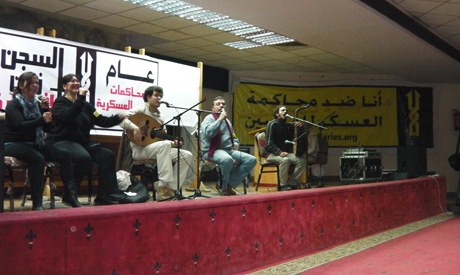
'No to Military Trials' marks 1st anniversary with music, testimonies
Following release of activists El-Behairy and Nabil, campaign marks first birthday with victims' personal accounts and musical performance by revolutionary band Eskenderella
Ahram Online, Monday 27 Feb 2012

No Military Trials
Eskendrella play at the close of the To Military Trials for Civilians press conference, on their anniversary
It's been one year since the night Amr El-Behairy, 32, was beaten by military personnel in front of Egypt's parliament building in downtown Cairo. He was later dragged out of a car, arrested, and sentenced to jail by a military court. Many others that night faced similar fates.
The same day, 26 February 2011, marked the launch of the "No to Military Trials for Civilians" campaign. On 24 March 2011, activists, human rights lawyers and families of detainees held their first group meeting at Cairo's Hisham Mubarak Law Centre. Today, the campaign boasts offices in the capital and Alexandria and conducts countrywide public-awareness campaigns.

The campaign advocates for the release of over 12,000 civilians, including minors, tried and sentenced by military courts in the absence of lawyers and witnesses – or the right to appeal. The conviction rate from these tribunals stands at 93 per cent, with 18 people having been sentenced to death, according to statistics provided late last year by military court head General Adel Morsy.

To date, official figures indicate that 2,613 detainees have so far been released. Finding accurate information about detainees or those facing trial, however, remains extremely difficult. Thousands of others, meanwhile, remain unaccounted for.

In October of last year, Field Marshal Hussein Tantawi, head of Egypt's ruling military council, announced a halt to the practice of referring civilians to military courts – with the notable exception of cases falling under Egypt's longstanding emergency laws. Many human rights activists, however, say the latter proviso renders the move meaningless.
The "No to Military Trials" campaign has been key to securing the release of numerous political detainees. El-Behairy, who was sentenced to five years in jail for attacking military personnel, became an icon of the campaign and Egypt's revolutionary movement. Last week, after almost a full year of campaigning on his behalf, El-Behairy was finally released by authorities.

On Sunday night, the "No to Military Trials" campaign marked its one-year anniversary with a press conference and concert at the Egyptian Journalists Syndicate. Families of those who remain in jail, released prisoners, and victims of abuse by the state all spoke at the event.
Among them was Samira Ibrahim, 25, who sued the government after being subjected to a forced virginity test by an army officer in March of last year. Rasha Abdel Rahman, another virginity-test victim and a witness in Ibrahim's case, announced that she, too, would be filing a complaint, drawing a standing ovation from those in attendance.
Rasha Azab, a well known journalist and activist detained on the same day as Ibrahim, also spoke about her arrest by authorities for broaching the issue in print.

The sister of detainee Mohamed Khaled, sentenced to three years in a military prison in Fayoum, said that she couldn’t recognise her brother when she paid him a visit because he had been so badly tortured.
Some people had even been tortured to death and buried in the desert, said recently-released detainee Abul Maaty. He says he was tortured continuously for four days after being detained in February of last year.
The brother of Essam Atta, 24, who, according to his family was tortured to death while in military detention, spoke about how the official medical report had said that his brother had died of a drug overdose. “We haven’t been able to investigate my brother’s death,” he said, verging on tears.
Mostafa Mohamed El-Ghareeb, a man in his 40s who was slapped with a jail sentence because the military thought he was somebody else, described how he had been stripped and beaten despite having a serious heart condition.

After each person spoke, the room erupted in spontaneous chants against the government and the ruling military council.

Military trial victim Alaa Abd El-Fattah, the renowned blogger detained for over a month by the army for refusing to accept the military court's legitimacy, also attended the event. He was accompanied by his activist wife Manal and mother Laila Soueif, who herself went on hunger strike to demand her son's release.

Ahmed Harrara, the 31-year-old dentist who lost both eyes to birdshot fired by Egyptian security forces, was likewise welcomed to the event with hearty applause.

"It was important to see many of the victims, but we have a long struggle ahead of us," said Maha Maamoun of the "No to Military Trials" campaign. "We're currently working on a new constitution. We’re also working on a draft law to change the articles of Egyptian military law that refer to civilians."

Alongside the release of El-Behairy, the "No to Military Trials" campaign was also recently able to celebrate activist Maikel Nabil's release from jail. The Egyptian blogger was sentenced to jail in March of last year for writing a blog critical of the ruling military council. Nabil withstood a 130-day hunger strike to protest his detention that led to his eventual release in January.

The evening concluded with a performance by revolutionary band Eskenderella, whose song Segn El-Alaa – "The citadel Prison" – is dedicated to those facing military trials.

Youth revolt in Microphone (old review)


It is strange seeing this review from 2010 now, knowing that the dissent and underground depicted in this film is the very source of the ongoing revolution in Egypt today.


Microphone caused quite a stir at this year’s Cairo International Film Festival. Not only did it win the award for best Arab film, but was commended by several award recipients at the ceremony
Menna Taher, Saturday 11 Dec 2010


6 / 13
Gallery


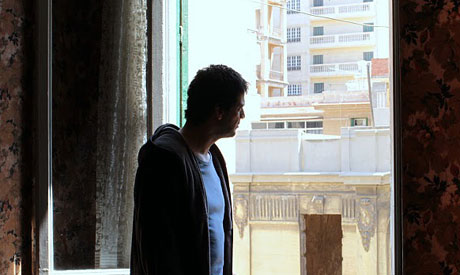
Microphone is fresh and rebellious, depicting youths who always manage to find a way to create art, 
despite serious oppression from the state and their families. Artists, who can’t get an exhibition space, 
use the walls as their canvasses and the all-girl metal band, Mascara, play music despite their parents’ disapproval.


Like Ahmed Abdalla’s debut feature film, HeliopolisMicrophone alternates between documentary and 
fiction, as it follows two film students Salma (Yousra El Lozy) and Magdy (Ahmed Magdy), who are 
making a documentary about Alexandria’s budding underground art scene.


Khaled (Khaled Abou El Naga), who has just returned from the US, is also drawn to the underground 
music scene and tries to help them find a venue to hold a concert after they have been shunned from performing at the National Centre for Arts. The official at the centre deemed the songs presented as too
 bold in their criticism of the regime and the graffiti on the street as eye pollution to which Khaled replies,
 “So what about the election posters.  Isn’tthat eye pollution?” This timely retort hit the right spot and 
received fervent applause during the screening of the film at the CIFF.


Yet despite the opposition the artists faced, the music in the film never stops. It seeps into headphones,
studios, apartments and the streets. Music is everywhere, from rap and hip hop, to rock, to more jazzy 
or oriental tunes.


Massar Egbary, a band also featured in Ibrahim El Batout’s, Hawi, was one of the highlights in the film. 
Their songs fit both the mood and their lyrics expressed the sentiments of the film’s themes. 


 The playful ever-moving camera mirrors the Alexandrian youths it represents, who are in constant 
motion roaming about the city on skateboards, running or walking, yet never in cars. The freedom in
 movement seen in this film is in stark contrast to Heliopolis, with the deadening traffic of Cairo.


Abdalla is quite masterful in depicting a city and its spirit. Along with the stories presented, he weaves 
footage of the city and its ordinary citizens going about their daily lives.


One interesting story was of a man, who spends the whole day selling cassette tapes, and whose only interlude is adjusting a poster of an election candidate next to his booth. Sometimes he wipes off koshary (a popular Egyptian dish) thrown on it, at other times he decorates it with lights, or draws glasses on the candidate’s face when the lights burn his eyes.


This can be traced to a police officer in Heliopolis whose highlight of the day was stroking a dog and 
feeding him. The story worked well because of its silent tone, something that Abdalla has mastered.


In telling a story through visuals Abdalla succeeds, it’s only when the script takes dominance, problems 
occur. The weakest part of the film was the script, which needed more development. Though it was 
mainly about the Alexandrian artists, it focused on those making the film and their failed love stories, like 
Khaled’s unrequited love for his past lover, Hadeer (Menna Shalaby) and the relationship between 
Salma and Magdy.


The film included snippets of a conversation between Khaled and Hadeer, something that didn’t add 
much to the film. The unnecessary dialogue may have been acceptable. if it had been more interesting.


There was a lot more to the lives of the Alexandrian artists presented that was only mentioned briefly. 
An elaboration on their lives was much needed. Perhaps if Ahmed Abdalla had listened to Salma when 
she told Magdy, “the film is not about us,” while shooting her for their documentary, this pitfall wouldn’t have occurred.


Yet the film’s deficiency in presenting a comprehensive storyline didn’t affect the film’s purpose, the 
dire need to rebel and find ways out despite restraints. The youths in the film would wear masks to stay anonymous musicians or jump out of a window aided by friends to escape unpleasant situations at 
home. It’s this spirit that complements the film.


Microphone will be commercially screened in cinemas.